On phones and tablets, Share can also offer installed messaging and social apps.
Prep 25 minCook 55 minServes 4
Ingredients
Why metric?
Metric avoids regional spoon ambiguity. US uses 5 mL tsp, 15 mL tbsp and 240 mL cup. Small masses stay in grams unless a verified recipe conversion exists. More on measurements
4 large capsicums (800 g)
400 g lean beef mince
190 g long-grain white rice (dry)
1 brown onion, finely chopped (150 g)
3 garlic cloves, chopped (15 g)
400 g canned no-added-salt tomatoes
60 ml extra-virgin olive oil (55 g)
12 g flat-leaf parsley, chopped
10 g fresh mint leaves, chopped
1 g ground cinnamon
250 g plain greek-style yoghurt, to serve
2.5 g iodised table salt, plus more to taste
Ground black pepper, to taste
Method
Heat the oven to 190C/375F. Slice the tops off the capsicums and keep them as lids. Pull out the seeds and white ribs.
Simmer the rice in plenty of water for 5 minutes only, then drain. It should still be chalky in the centre; it finishes cooking inside the capsicums and would go to mush if boiled through now.
Warm two-thirds of the oil in a frying pan and cook the onion for 6 minutes. Add the beef and brown it well, 6-8 minutes, breaking up the lumps. Stir in the garlic and cinnamon for a minute.
Tip in half the tomatoes with the salt and simmer 5 minutes, then take off the heat and fold through the par-cooked rice, parsley and mint.
Stand the capsicums in a snug baking dish and fill them three-quarters full, leaving room for the rice to swell. Replace the lids. Spoon any filling that will not fit into the gaps between them, where it bakes into the sauce.
Pour the remaining tomatoes and 150 ml water around the base, drizzle with the last of the oil, cover tightly with foil and bake 45 minutes. Uncover and bake 10 minutes more, until the capsicum skins are wrinkled and a knife slides through the side without resistance.
Rest 10 minutes before serving, spooning the pan juices over. Serve with the yoghurt alongside.
Safety and storage
Cook to
71°C / 160°F in the centre (minced meat and sausages)
Keeps
2 days refrigerated below 5°C
Reheat to
steaming hot, at least 60°C
Colour and clear juices are not a reliable test. Check the thickest part with a thermometer.
Cooked rice and pasta keep two days rather than three, so this dish takes the shorter time. Cool and cover within two hours, split large amounts into shallow containers, and reheat until steaming hot, at least 60°C.
These options describe ways to change the workload around a written recipe method. They do not certify a recipe as accessible or safe for a particular person, and they do not silently rewrite the canonical ingredients, quantities, cooking temperatures or food-safety requirements. Trial the real task and use a different method or recipe when a generic workflow change would be inappropriate.
Workflow option
Reduce the chopping step before changing knife technique
If chopping is one of the heavier parts of this method, first check whether the same ingredient can be bought or prepared in a form that removes some knife work.
Consider: Compare pre-cut, frozen, pre-portioned or otherwise prepared versions only where they still perform the same culinary role in this recipe.
Trade-offs
Convenience formats can cost more or use more storage space.
Texture, seasoning, sodium or package size can differ, so check the actual product rather than assuming it is equivalent.
This method has at least moderate lifting or transfer demand, so the heaviest loaded step is worth planning before cooking begins.
Consider: Where the method allows it, consider smaller cookware, split cold loads, sliding across a stable surface or a prepared landing zone rather than carrying one awkward load.
Trade-offs
Splitting a load can add trips, pours or cleanup, so it is useful only when the complete sequence is easier to control.
Hot transfers need a clear destination and should not be improvised after the vessel is already loaded.
Compare a no-drain method instead of improvising the liquid ratio
The canonical method includes stovetop draining, which is a distinct hot-water transfer rather than a small wording detail.
Consider: Do not generically rewrite water or liquid quantities. Compare a tested no-drain cooking method or another recipe whose canonical method already avoids stovetop draining.
Trade-offs
A no-drain technique can change texture or timing and is not automatically interchangeable with the written method.
Changing liquid ratios without recipe development can affect doneness and food safety.
This method contains a recorded hot-liquid transfer, so route, load and landing position matter more than simply shortening the written step.
Consider: Clear the destination and route first; reduce the load only when that genuinely simplifies the sequence. If the transfer remains the main barrier, compare recipes whose canonical methods do not contain one.
Trade-offs
Extra pours can create additional spill opportunities even when each container is lighter.
A shorter route is not useful if it ends at an unstable or unreachable landing surface.
The method includes high bimanual demand, so look for steps where one hand is expected to hold or stabilise while the other cuts, opens, stirs or pours.
Consider: Stabilise the stationary part of the task where appropriate, or change the order so one hand is not being asked to perform two jobs at once.
Trade-offs
Clamps, spikes, mats and other stabilisers introduce their own pinch, puncture or setup considerations.
Reordering a workflow must not separate steps that depend on immediate timing, temperature or food safety.
The recorded method has more than light cleanup, which can matter as much as active preparation when the meal is finished.
Consider: Stage safe cleanup steps where they do not compete with heat or attention, and compare one-vessel methods only when the resulting vessel does not become too heavy or awkward.
Trade-offs
Cleaning during cooking is not useful if it creates divided-attention risk around heat.
One large vessel can be harder to move and wash than two smaller ones.
Recipes whose current method review records low visual reliance, making them useful examples when comparing methods that depend less heavily on visual checking.
Most of the work happens before anything is heated and the oven stage tolerates a wait, which is the shape this essay looks for; listed as an example of a method demand and not an accessibility certification.
Baked Stuffed Capsicums with Beef, Rice & Herbs
Serves 4 · Prep 25 min · Cook 55 min
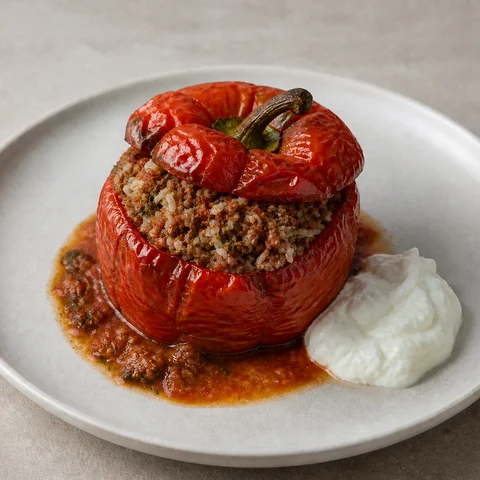
Whole capsicums filled with beef mince, rice, tomato, parsley and mint, baked covered until soft and sweet, served with thick yoghurt.
Ingredients
4 large capsicums (800 g)
400 g lean beef mince
190 g long-grain white rice (dry)
1 brown onion, finely chopped (150 g)
3 garlic cloves, chopped (15 g)
400 g canned no-added-salt tomatoes
60 ml extra-virgin olive oil (55 g)
12 g flat-leaf parsley, chopped
10 g fresh mint leaves, chopped
1 g ground cinnamon
250 g plain greek-style yoghurt, to serve
2.5 g iodised table salt, plus more to taste
Ground black pepper, to taste
Approximate per serving
2630 kJ / 628.5 kcal · protein 32.6 g · carbohydrate 53.2 g · fibre 5.6 g · fat 30.1 g · sodium 371.6 mg
Method
Heat the oven to 190C/375F. Slice the tops off the capsicums and keep them as lids. Pull out the seeds and white ribs.
Simmer the rice in plenty of water for 5 minutes only, then drain. It should still be chalky in the centre; it finishes cooking inside the capsicums and would go to mush if boiled through now.
Warm two-thirds of the oil in a frying pan and cook the onion for 6 minutes. Add the beef and brown it well, 6-8 minutes, breaking up the lumps. Stir in the garlic and cinnamon for a minute.
Tip in half the tomatoes with the salt and simmer 5 minutes, then take off the heat and fold through the par-cooked rice, parsley and mint.
Stand the capsicums in a snug baking dish and fill them three-quarters full, leaving room for the rice to swell. Replace the lids. Spoon any filling that will not fit into the gaps between them, where it bakes into the sauce.
Pour the remaining tomatoes and 150 ml water around the base, drizzle with the last of the oil, cover tightly with foil and bake 45 minutes. Uncover and bake 10 minutes more, until the capsicum skins are wrinkled and a knife slides through the side without resistance.
Rest 10 minutes before serving, spooning the pan juices over. Serve with the yoghurt alongside.
Safety and storage
Cook to
71°C / 160°F in the centre (minced meat and sausages)
Keeps
2 days refrigerated below 5°C
Reheat to
steaming hot, at least 60°C
Colour and clear juices are not a reliable test. Check the thickest part with a thermometer.
Cooked rice and pasta keep two days rather than three, so this dish takes the shorter time. Cool and cover within two hours, split large amounts into shallow containers, and reheat until steaming hot, at least 60°C.
Everyday Mediterranean-style cooking, which has promising early evidence in psoriasis and is good eating in its own right. Food like this sits alongside the care your clinician gives you rather than replacing any of it.