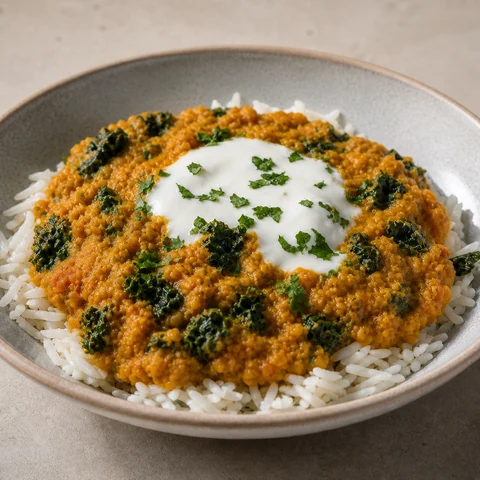
Kale and Spinach Dhal with Yoghurt and Basmati Rice
Red lentils cooked down with onion, ginger and warm spices, wilted with kale and baby spinach and finished with lemon and a spoonful of yoghurt, over basmati.
On phones and tablets, Share can also offer installed messaging and social apps.
Prep 15 minCook 35 minServes 4
Ingredients
Why metric?
Metric avoids regional spoon ambiguity. US uses 5 mL tsp, 15 mL tbsp and 240 mL cup. Small masses stay in grams unless a verified recipe conversion exists. More on measurements
300 g dried red lentils (dry)
1,080 ml water (1,080 g)
1 medium brown onion, finely chopped (150 g)
3 garlic cloves, finely chopped (15 g)
15 g fresh ginger, grated
3 g ground cumin
3 g ground coriander
4 g mild curry powder
200 g canned no-added-salt tomatoes
120 g kale, stems stripped and finely shredded
30 g baby spinach
50 ml neutral oil (45 g)
300 g natural low-fat yoghurt
320 g basmati rice (dry)
20 ml lemon juice (20 g)
8 g flat-leaf parsley, chopped
1 g iodised table salt
Ground black pepper, to taste
Method
Rinse the lentils until the water runs clear. Rinse the rice separately and cook it in unsalted water by your usual method.
Warm the oil in a large saucepan and cook the onion with the salt over medium heat for 8-10 minutes, until soft and just beginning to catch gold at the edges.
Add the garlic, ginger, cumin, coriander and curry powder and stir 30-40 seconds, until the pan smells toasted and the spices darken slightly. Burnt spice tastes bitter all the way through, so keep it moving.
Tip in the lentils, tomatoes and water. Bring to the boil, skim off any foam, then simmer uncovered for 20-25 minutes, stirring now and then and scraping the base.
It is done when the lentils have lost their shape entirely and the dhal falls thickly from the spoon rather than pouring. Add hot water if it thickens past that.
Stir the kale through and simmer 4-5 minutes, until it has softened and lost its squeak, then stir the spinach through a handful at a time and cook 1 minute more, only until it has just collapsed and turned dark green.
Take off the heat, stir in the lemon juice and pepper, and serve over the rice with the yoghurt spooned on top and the parsley scattered over.
Serve
Kale does the work spinach used to do here and carries about a fiftieth of the oxalate for the same weight, which is why the greens are mostly kale. The yoghurt is not a garnish either: calcium eaten in the same meal binds oxalate in the gut so it leaves in the stool instead of the urine.
Safety and storage
Keeps
2 days refrigerated below 5°C
Reheat to
steaming hot, at least 60°C
Cooked rice and pasta keep two days rather than three, so this dish takes the shorter time. Cool and cover within two hours, split large amounts into shallow containers, and reheat until steaming hot, at least 60°C.
These options describe ways to change the workload around a written recipe method. They do not certify a recipe as accessible or safe for a particular person, and they do not silently rewrite the canonical ingredients, quantities, cooking temperatures or food-safety requirements. Trial the real task and use a different method or recipe when a generic workflow change would be inappropriate.
Workflow option
Reduce the chopping step before changing knife technique
If chopping is one of the heavier parts of this method, first check whether the same ingredient can be bought or prepared in a form that removes some knife work.
Consider: Compare pre-cut, frozen, pre-portioned or otherwise prepared versions only where they still perform the same culinary role in this recipe.
Trade-offs
Convenience formats can cost more or use more storage space.
Texture, seasoning, sodium or package size can differ, so check the actual product rather than assuming it is equivalent.
Recipes whose current method uses no more than one cooking vessel, which may reduce pan handling and cleanup without guaranteeing a lighter overall task.
Spinach appears with yoghurt rather than being removed, which is what the dose-and-context argument looks like on a plate.
Kale and Spinach Dhal with Yoghurt and Basmati Rice
Serves 4 · Prep 15 min · Cook 35 min
Red lentils cooked down with onion, ginger and warm spices, wilted with kale and baby spinach and finished with lemon and a spoonful of yoghurt, over basmati.
Ingredients
300 g dried red lentils (dry)
1,080 ml water (1,080 g)
1 medium brown onion, finely chopped (150 g)
3 garlic cloves, finely chopped (15 g)
15 g fresh ginger, grated
3 g ground cumin
3 g ground coriander
4 g mild curry powder
200 g canned no-added-salt tomatoes
120 g kale, stems stripped and finely shredded
30 g baby spinach
50 ml neutral oil (45 g)
300 g natural low-fat yoghurt
320 g basmati rice (dry)
20 ml lemon juice (20 g)
8 g flat-leaf parsley, chopped
1 g iodised table salt
Ground black pepper, to taste
Approximate per serving
2946 kJ / 704 kcal · protein 30.1 g · carbohydrate 102.7 g · fibre 15.9 g · fat 14.2 g · sodium 215 mg
Method
Rinse the lentils until the water runs clear. Rinse the rice separately and cook it in unsalted water by your usual method.
Warm the oil in a large saucepan and cook the onion with the salt over medium heat for 8-10 minutes, until soft and just beginning to catch gold at the edges.
Add the garlic, ginger, cumin, coriander and curry powder and stir 30-40 seconds, until the pan smells toasted and the spices darken slightly. Burnt spice tastes bitter all the way through, so keep it moving.
Tip in the lentils, tomatoes and water. Bring to the boil, skim off any foam, then simmer uncovered for 20-25 minutes, stirring now and then and scraping the base.
It is done when the lentils have lost their shape entirely and the dhal falls thickly from the spoon rather than pouring. Add hot water if it thickens past that.
Stir the kale through and simmer 4-5 minutes, until it has softened and lost its squeak, then stir the spinach through a handful at a time and cook 1 minute more, only until it has just collapsed and turned dark green.
Take off the heat, stir in the lemon juice and pepper, and serve over the rice with the yoghurt spooned on top and the parsley scattered over.
Serve
Kale does the work spinach used to do here and carries about a fiftieth of the oxalate for the same weight, which is why the greens are mostly kale. The yoghurt is not a garnish either: calcium eaten in the same meal binds oxalate in the gut so it leaves in the stool instead of the urine.
Safety and storage
Keeps
2 days refrigerated below 5°C
Reheat to
steaming hot, at least 60°C
Cooked rice and pasta keep two days rather than three, so this dish takes the shorter time. Cool and cover within two hours, split large amounts into shallow containers, and reheat until steaming hot, at least 60°C.
Cooking around the things that genuinely lower the risk of stones returning — fluid, sodium, and keeping dietary calcium adequate rather than cutting it. Which matters most depends on your stone type and your metabolic results, so this belongs alongside your own medical and dietetic care.