On phones and tablets, Share can also offer installed messaging and social apps.
Prep 15 minCook 30 minServes 2
Ingredients
Why metric?
Metric avoids regional spoon ambiguity. US uses 5 mL tsp, 15 mL tbsp and 240 mL cup. Small masses stay in grams unless a verified recipe conversion exists. More on measurements
35 ml extra-virgin olive oil (32 g)
1 small brown onion, finely chopped (100 g)
120 g carrot, diced
2 celery sticks, diced (100 g)
2 garlic cloves, chopped (10 g)
400 g canned no-added-salt tomatoes
150 ml reduced-salt vegetable stock (150 g)
450 ml water (450 g)
240 g canned cannellini beans, drained and rinsed
130 g macaroni (dry)
12 g fresh basil leaves, torn
15 g parmesan, finely grated
Iodised table salt, to taste
Ground black pepper, to taste
Method
Warm the oil in a large saucepan over medium-low heat and cook the onion, carrot and celery with a pinch of salt for 10 minutes, stirring occasionally. Take your time here: this slow softening is where the sweetness comes from.
Add the garlic for a minute, then the tomatoes, crushing them against the pan, with the stock and water. Bring to the boil and simmer 12 minutes.
Add the beans and macaroni and simmer 8-10 minutes more, until the pasta is tender. The pasta drinks up a good deal of the broth, which is how minestrone is meant to end up; loosen with hot water if it goes past thick to stodgy.
Stir in the basil, grind in pepper and taste for salt.
Ladle into bowls and finish with the parmesan.
Safety and storage
Keeps
2 days refrigerated below 5°C
Reheat to
steaming hot, at least 60°C
Cooked rice and pasta keep two days rather than three, so this dish takes the shorter time. Cool and cover within two hours, split large amounts into shallow containers, and reheat until steaming hot, at least 60°C.
These options describe ways to change the workload around a written recipe method. They do not certify a recipe as accessible or safe for a particular person, and they do not silently rewrite the canonical ingredients, quantities, cooking temperatures or food-safety requirements. Trial the real task and use a different method or recipe when a generic workflow change would be inappropriate.
Workflow option
Reduce the chopping step before changing knife technique
If chopping is one of the heavier parts of this method, first check whether the same ingredient can be bought or prepared in a form that removes some knife work.
Consider: Compare pre-cut, frozen, pre-portioned or otherwise prepared versions only where they still perform the same culinary role in this recipe.
Trade-offs
Convenience formats can cost more or use more storage space.
Texture, seasoning, sodium or package size can differ, so check the actual product rather than assuming it is equivalent.
Identify the high-grip step instead of adapting the whole recipe
The recorded method includes at least moderate grip demand, but that demand may come from opening, stabilising, stirring, cookware or another specific step.
Consider: Identify the exact grip-heavy action and trial one change at a time, such as stabilisation, a lower-force opener or lighter cookware where that action actually occurs.
Trade-offs
A tool that reduces one grip demand can add setup, cleaning or another movement.
Do not assume a generic aid fits the hand position, force direction or hot-task sequence in this recipe.
This method has at least moderate lifting or transfer demand, so the heaviest loaded step is worth planning before cooking begins.
Consider: Where the method allows it, consider smaller cookware, split cold loads, sliding across a stable surface or a prepared landing zone rather than carrying one awkward load.
Trade-offs
Splitting a load can add trips, pours or cleanup, so it is useful only when the complete sequence is easier to control.
Hot transfers need a clear destination and should not be improvised after the vessel is already loaded.
This method contains a recorded hot-liquid transfer, so route, load and landing position matter more than simply shortening the written step.
Consider: Clear the destination and route first; reduce the load only when that genuinely simplifies the sequence. If the transfer remains the main barrier, compare recipes whose canonical methods do not contain one.
Trade-offs
Extra pours can create additional spill opportunities even when each container is lighter.
A shorter route is not useful if it ends at an unstable or unreachable landing surface.
Recipes whose current method review records low visual reliance, making them useful examples when comparing methods that depend less heavily on visual checking.
Recipes whose current method uses no more than one cooking vessel, which may reduce pan handling and cleanup without guaranteeing a lighter overall task.
Heavy on chopping and light on holding, which makes it a clear test of whether a stabilised board changes the job; listed as an example of a method demand and not an accessibility certification.
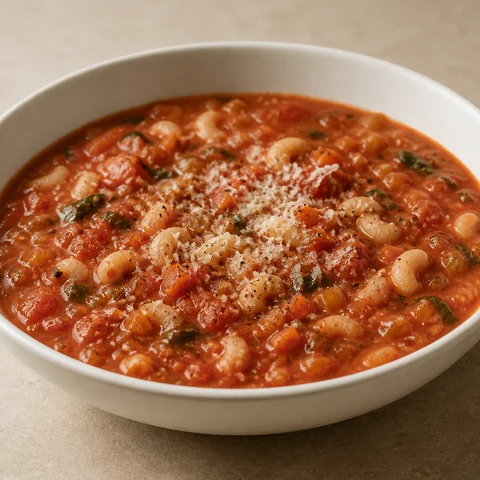
Minestrone with Macaroni & Cannellini Beans
Serves 2 · Prep 15 min · Cook 30 min
A soft-cooked vegetable soup with cannellini beans and small pasta, finished with basil and grated parmesan.
Ingredients
35 ml extra-virgin olive oil (32 g)
1 small brown onion, finely chopped (100 g)
120 g carrot, diced
2 celery sticks, diced (100 g)
2 garlic cloves, chopped (10 g)
400 g canned no-added-salt tomatoes
150 ml reduced-salt vegetable stock (150 g)
450 ml water (450 g)
240 g canned cannellini beans, drained and rinsed
130 g macaroni (dry)
12 g fresh basil leaves, torn
15 g parmesan, finely grated
Iodised table salt, to taste
Ground black pepper, to taste
Approximate per serving
2536 kJ / 606.2 kcal · protein 21.8 g · carbohydrate 73.8 g · fibre 16.7 g · fat 20 g · sodium 690.4 mg
Method
Warm the oil in a large saucepan over medium-low heat and cook the onion, carrot and celery with a pinch of salt for 10 minutes, stirring occasionally. Take your time here: this slow softening is where the sweetness comes from.
Add the garlic for a minute, then the tomatoes, crushing them against the pan, with the stock and water. Bring to the boil and simmer 12 minutes.
Add the beans and macaroni and simmer 8-10 minutes more, until the pasta is tender. The pasta drinks up a good deal of the broth, which is how minestrone is meant to end up; loosen with hot water if it goes past thick to stodgy.
Stir in the basil, grind in pepper and taste for salt.
Ladle into bowls and finish with the parmesan.
Safety and storage
Keeps
2 days refrigerated below 5°C
Reheat to
steaming hot, at least 60°C
Cooked rice and pasta keep two days rather than three, so this dish takes the shorter time. Cool and cover within two hours, split large amounts into shallow containers, and reheat until steaming hot, at least 60°C.
Everyday Mediterranean-style cooking, which has promising early evidence in psoriasis and is good eating in its own right. Food like this sits alongside the care your clinician gives you rather than replacing any of it.