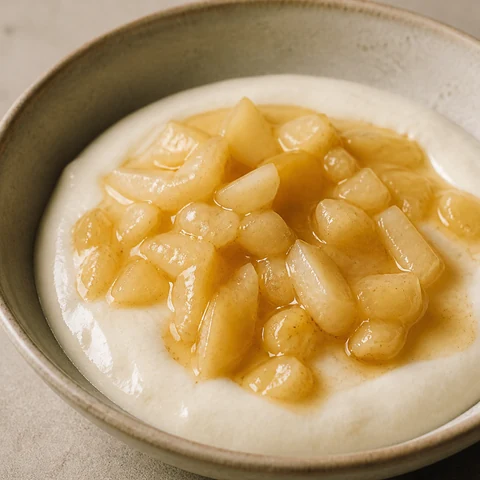
A whole tub of cottage cheese blitzed until the curd disappears and it turns to pourable cream, under pear poached soft and finished in a buttery honey syrup.
On phones and tablets, Share can also offer installed messaging and social apps.
Prep 10 minCook 18 minServes 2
Ingredients
Why metric?
Metric avoids regional spoon ambiguity. US uses 5 mL tsp, 15 mL tbsp and 240 mL cup. Small masses stay in grams unless a verified recipe conversion exists. More on measurements
250 g cottage cheese (1 tub)
2 pears, peeled, cored and diced (320 g)
200 ml water (200 g)
55 g honey
25 g unsalted butter
120 ml reduced-fat milk (124 g)
60 g skim milk powder
8 ml lemon juice (8 g)
3 g vanilla extract
0.5 g ground cinnamon
Method
Peel the pears, quarter them and cut the cores out generously. The gritty stone cells sit in a ring around the core and are the one part of a pear that never softens however long it cooks. Dice the flesh no bigger than a fingernail.
Bring the water, half the honey, the lemon juice and the cinnamon to a simmer in a small pan. Slide the pear in and cook 12-15 minutes at a bare tremble, until a piece collapses under the back of a spoon with no resistance at all.
Lift the pear out with a slotted spoon. Boil the syrup hard for 2 minutes until it has reduced by half, then take it off the heat and swirl the butter in a piece at a time until it goes glossy and slightly thick. Tip the pear back in and turn it over in the syrup.
Blitz the cottage cheese with the milk, the milk powder and the vanilla for a good minute. It passes through three stages: lumpy, then grainy, then abruptly smooth and pourable. Stop at the third, not the second, and scrape the sides down at least once on the way.
Divide the whipped cheese between two bowls and spoon the pear and its syrup over. Trickle the last of the honey on top.
Both halves keep two days covered in the fridge, so the poaching is worth doing for four servings while the pan is out.
Safety and storage
Keeps
3 days refrigerated below 5°C
Reheat to
steaming hot, at least 60°C
Cool and cover within two hours of cooking; split large amounts into shallow containers so they chill quickly. Reheat until steaming hot, at least 60°C.
These options describe ways to change the workload around a written recipe method. They do not certify a recipe as accessible or safe for a particular person, and they do not silently rewrite the canonical ingredients, quantities, cooking temperatures or food-safety requirements. Trial the real task and use a different method or recipe when a generic workflow change would be inappropriate.
Workflow option
Move non-heat preparation to a seated workstation
Some or all preparation may be separable from the heat-side work, even when the complete recipe cannot be performed from one position.
Consider: Stage ingredients and complete suitable measuring, opening and cold preparation at a stable seated station before the stove or oven is active, while keeping heat-side tasks as a separate plan.
Trade-offs
Moving prep can increase carrying if ingredients and tools are stored far from the seated station.
Perishable foods still require normal temperature control during staged preparation.
Recipes whose current method review records low visual reliance, making them useful examples when comparing methods that depend less heavily on visual checking.
Recipes whose current method uses no more than one cooking vessel, which may reduce pan handling and cleanup without guaranteeing a lighter overall task.
A modest volume that still carries its share of the day, illustrating the density-over-size approach the essay argues for.
Whipped Cottage Cheese with Butter-Poached Pear
Serves 2 · Prep 10 min · Cook 18 min
A whole tub of cottage cheese blitzed until the curd disappears and it turns to pourable cream, under pear poached soft and finished in a buttery honey syrup.
Ingredients
250 g cottage cheese (1 tub)
2 pears, peeled, cored and diced (320 g)
200 ml water (200 g)
55 g honey
25 g unsalted butter
120 ml reduced-fat milk (124 g)
60 g skim milk powder
8 ml lemon juice (8 g)
3 g vanilla extract
0.5 g ground cinnamon
Approximate per serving
2423 kJ / 579.1 kcal · protein 34.7 g · carbohydrate 62.3 g · fibre 4.5 g · fat 18.4 g · sodium 501.2 mg
Method
Peel the pears, quarter them and cut the cores out generously. The gritty stone cells sit in a ring around the core and are the one part of a pear that never softens however long it cooks. Dice the flesh no bigger than a fingernail.
Bring the water, half the honey, the lemon juice and the cinnamon to a simmer in a small pan. Slide the pear in and cook 12-15 minutes at a bare tremble, until a piece collapses under the back of a spoon with no resistance at all.
Lift the pear out with a slotted spoon. Boil the syrup hard for 2 minutes until it has reduced by half, then take it off the heat and swirl the butter in a piece at a time until it goes glossy and slightly thick. Tip the pear back in and turn it over in the syrup.
Blitz the cottage cheese with the milk, the milk powder and the vanilla for a good minute. It passes through three stages: lumpy, then grainy, then abruptly smooth and pourable. Stop at the third, not the second, and scrape the sides down at least once on the way.
Divide the whipped cheese between two bowls and spoon the pear and its syrup over. Trickle the last of the honey on top.
Both halves keep two days covered in the fridge, so the poaching is worth doing for four servings while the pan is out.
Safety and storage
Keeps
3 days refrigerated below 5°C
Reheat to
steaming hot, at least 60°C
Cool and cover within two hours of cooking; split large amounts into shallow containers so they chill quickly. Reheat until steaming hot, at least 60°C.
Meals built soft and small-particle, which is the dietary lever a recipe can genuinely control and one current guidance supports. Portion size is yours to set: these are written at an ordinary serving and divide in two if you are eating smaller and more often. Diagnosing, curing or treating gastroparesis is not something food does. If eating is not going in, if you are dehydrated or losing weight without meaning to, that needs a clinician rather than a different recipe.