On phones and tablets, Share can also offer installed messaging and social apps.
Prep 10 minCook 25 minServes 2
Ingredients
Why metric?
Metric avoids regional spoon ambiguity. US uses 5 mL tsp, 15 mL tbsp and 240 mL cup. Small masses stay in grams unless a verified recipe conversion exists. More on measurements
600 g small potatoes, skins on, halved
4 eggs (204 g)
25 g capers, drained and rinsed
1 small red onion, finely sliced (100 g)
15 g fresh dill, chopped
35 ml extra-virgin olive oil (32 g)
20 ml red wine vinegar (20 g)
1 g iodised table salt
Ground black pepper, to taste
Method
Put the potatoes in cold unsalted water, bring to the boil and simmer 18-20 minutes, until a knife goes in with no resistance.
Lower the eggs into a separate pan of already-boiling water and simmer exactly 8 minutes for a set-but-creamy yolk, then cool them under cold running water and peel.
Whisk the vinegar, oil, salt and pepper together with the sliced onion.
Drain the potatoes and tip them straight into the dressing while they are still steaming. A hot potato absorbs dressing; a cold one wears it. This is the whole trick of the dish.
Turn everything gently, then add the capers and dill. Quarter the eggs and settle them on top rather than stirring them in.
Serve
Good warm or at room temperature, and it does not want to be fridge-cold. A soft yolk is not fully cooked. Guidance is to avoid undercooked egg if you are pregnant, over 70, under 2, or your immune system is low or suppressed — which includes many people on immune-modifying medicines. Cook the yolk through instead: the dish still works.
Safety and storage
Keeps
3 days refrigerated below 5°C
Reheat to
steaming hot, at least 60°C
Cool and cover within two hours of cooking; split large amounts into shallow containers so they chill quickly. Reheat until steaming hot, at least 60°C.
These options describe ways to change the workload around a written recipe method. They do not certify a recipe as accessible or safe for a particular person, and they do not silently rewrite the canonical ingredients, quantities, cooking temperatures or food-safety requirements. Trial the real task and use a different method or recipe when a generic workflow change would be inappropriate.
Workflow option
Reduce peak lifting and transfer load
This method has at least moderate lifting or transfer demand, so the heaviest loaded step is worth planning before cooking begins.
Consider: Where the method allows it, consider smaller cookware, split cold loads, sliding across a stable surface or a prepared landing zone rather than carrying one awkward load.
Trade-offs
Splitting a load can add trips, pours or cleanup, so it is useful only when the complete sequence is easier to control.
Hot transfers need a clear destination and should not be improvised after the vessel is already loaded.
Compare a no-drain method instead of improvising the liquid ratio
The canonical method includes stovetop draining, which is a distinct hot-water transfer rather than a small wording detail.
Consider: Do not generically rewrite water or liquid quantities. Compare a tested no-drain cooking method or another recipe whose canonical method already avoids stovetop draining.
Trade-offs
A no-drain technique can change texture or timing and is not automatically interchangeable with the written method.
Changing liquid ratios without recipe development can affect doneness and food safety.
This method contains a recorded hot-liquid transfer, so route, load and landing position matter more than simply shortening the written step.
Consider: Clear the destination and route first; reduce the load only when that genuinely simplifies the sequence. If the transfer remains the main barrier, compare recipes whose canonical methods do not contain one.
Trade-offs
Extra pours can create additional spill opportunities even when each container is lighter.
A shorter route is not useful if it ends at an unstable or unreachable landing surface.
The method includes high bimanual demand, so look for steps where one hand is expected to hold or stabilise while the other cuts, opens, stirs or pours.
Consider: Stabilise the stationary part of the task where appropriate, or change the order so one hand is not being asked to perform two jobs at once.
Trade-offs
Clamps, spikes, mats and other stabilisers introduce their own pinch, puncture or setup considerations.
Reordering a workflow must not separate steps that depend on immediate timing, temperature or food safety.
Recipes whose current method review records low visual reliance, making them useful examples when comparing methods that depend less heavily on visual checking.
Recipes whose current method uses no more than one cooking vessel, which may reduce pan handling and cleanup without guaranteeing a lighter overall task.
Recipes whose current method records no more than 10 minutes of active preparation before or around cooking.
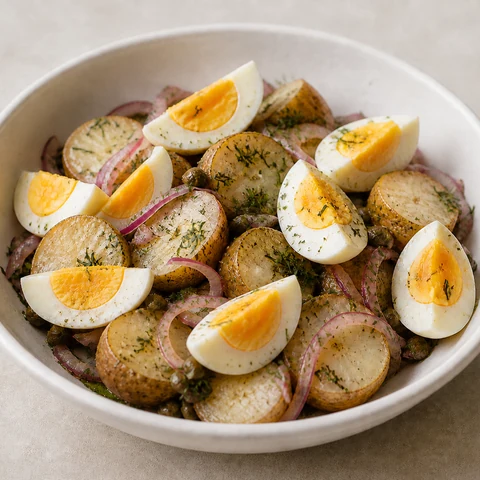
Potato, Egg and Caper Salad
Serves 2 · Prep 10 min · Cook 25 min
Warm potatoes dressed while they are still steaming so they drink up the dressing, with soft-boiled eggs, capers and a lot of dill.
Ingredients
600 g small potatoes, skins on, halved
4 eggs (204 g)
25 g capers, drained and rinsed
1 small red onion, finely sliced (100 g)
15 g fresh dill, chopped
35 ml extra-virgin olive oil (32 g)
20 ml red wine vinegar (20 g)
1 g iodised table salt
Ground black pepper, to taste
Approximate per serving
1964 kJ / 469.4 kcal · protein 20.1 g · carbohydrate 38.1 g · fibre 5.1 g · fat 24.9 g · sodium 657 mg
Method
Put the potatoes in cold unsalted water, bring to the boil and simmer 18-20 minutes, until a knife goes in with no resistance.
Lower the eggs into a separate pan of already-boiling water and simmer exactly 8 minutes for a set-but-creamy yolk, then cool them under cold running water and peel.
Whisk the vinegar, oil, salt and pepper together with the sliced onion.
Drain the potatoes and tip them straight into the dressing while they are still steaming. A hot potato absorbs dressing; a cold one wears it. This is the whole trick of the dish.
Turn everything gently, then add the capers and dill. Quarter the eggs and settle them on top rather than stirring them in.
Serve
Good warm or at room temperature, and it does not want to be fridge-cold. A soft yolk is not fully cooked. Guidance is to avoid undercooked egg if you are pregnant, over 70, under 2, or your immune system is low or suppressed — which includes many people on immune-modifying medicines. Cook the yolk through instead: the dish still works.
Safety and storage
Keeps
3 days refrigerated below 5°C
Reheat to
steaming hot, at least 60°C
Cool and cover within two hours of cooking; split large amounts into shallow containers so they chill quickly. Reheat until steaming hot, at least 60°C.
Cooking for a diagnosed coeliac diet, where getting gluten out is the treatment and the rest is making that easy to live with. Diagnosis, testing and follow-up stay with your own team, and no recipe can vouch for your kitchen or a manufacturer’s production line.