On phones and tablets, Share can also offer installed messaging and social apps.
Prep 12 minCook 28 minServes 2
Ingredients
Why metric?
Metric avoids regional spoon ambiguity. US uses 5 mL tsp, 15 mL tbsp and 240 mL cup. Small masses stay in grams unless a verified recipe conversion exists. More on measurements
160 g red lentils (dry), rinsed
250 g carrots, sliced
1 small brown onion, chopped (100 g)
2 garlic cloves, chopped (10 g)
3 g ground cumin
2 g ground coriander
30 ml extra-virgin olive oil (27 g)
300 ml reduced-salt vegetable stock (300 g)
450 ml water (450 g)
20 ml lemon juice (20 g)
8 g flat-leaf parsley, chopped
4 slices wholegrain bread (120 g), to serve
Ground black pepper, to taste
Method
Warm the oil in a saucepan over medium heat and cook the onion and carrot for 8 minutes, stirring, until the onion is translucent.
Add the garlic, cumin and coriander and stir for 1 minute until fragrant.
Add the lentils, stock and water, bring to the boil, then turn down to a steady simmer, half-cover and cook 20-25 minutes. The soup is ready when the lentils have collapsed and the carrot gives under a spoon.
Blend to a rough puree with a stick blender, or leave it chunky if you prefer. Keep the blender head submerged so it does not spit.
Stir in the lemon juice and plenty of pepper, taste, and add more lemon if it tastes flat. Serve topped with parsley, with the bread alongside.
Safety and storage
Keeps
3 days refrigerated below 5°C
Reheat to
steaming hot, at least 60°C
Cool and cover within two hours of cooking; split large amounts into shallow containers so they chill quickly. Reheat until steaming hot, at least 60°C.
These options describe ways to change the workload around a written recipe method. They do not certify a recipe as accessible or safe for a particular person, and they do not silently rewrite the canonical ingredients, quantities, cooking temperatures or food-safety requirements. Trial the real task and use a different method or recipe when a generic workflow change would be inappropriate.
Change the workflow or compare another method
Plan the hot-liquid transfer before heat starts
This method contains a recorded hot-liquid transfer, so route, load and landing position matter more than simply shortening the written step.
Consider: Clear the destination and route first; reduce the load only when that genuinely simplifies the sequence. If the transfer remains the main barrier, compare recipes whose canonical methods do not contain one.
Trade-offs
Extra pours can create additional spill opportunities even when each container is lighter.
A shorter route is not useful if it ends at an unstable or unreachable landing surface.
Some or all preparation may be separable from the heat-side work, even when the complete recipe cannot be performed from one position.
Consider: Stage ingredients and complete suitable measuring, opening and cold preparation at a stable seated station before the stove or oven is active, while keeping heat-side tasks as a separate plan.
Trade-offs
Moving prep can increase carrying if ingredients and tools are stored far from the seated station.
Perishable foods still require normal temperature control during staged preparation.
The method includes high bimanual demand, so look for steps where one hand is expected to hold or stabilise while the other cuts, opens, stirs or pours.
Consider: Stabilise the stationary part of the task where appropriate, or change the order so one hand is not being asked to perform two jobs at once.
Trade-offs
Clamps, spikes, mats and other stabilisers introduce their own pinch, puncture or setup considerations.
Reordering a workflow must not separate steps that depend on immediate timing, temperature or food safety.
Recipes whose current method review records low visual reliance, making them useful examples when comparing methods that depend less heavily on visual checking.
Recipes whose current method uses no more than one cooking vessel, which may reduce pan handling and cleanup without guaranteeing a lighter overall task.
The method is add and stir in any order, so no step asks for two hands in the same second; listed to illustrate a method demand and not an accessibility certification.
A single pot of hot liquid that can be ladled into bowls rather than carried, which illustrates a method demand and is not an accessibility certification.
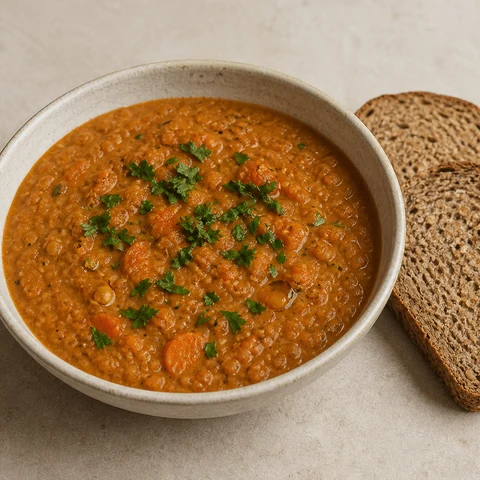
Red Lentil, Carrot & Cumin Soup
Serves 2 · Prep 12 min · Cook 28 min
A thick soup of red lentils and carrot spiced with cumin and coriander, sharpened with lemon and served with bread.
Ingredients
160 g red lentils (dry), rinsed
250 g carrots, sliced
1 small brown onion, chopped (100 g)
2 garlic cloves, chopped (10 g)
3 g ground cumin
2 g ground coriander
30 ml extra-virgin olive oil (27 g)
300 ml reduced-salt vegetable stock (300 g)
450 ml water (450 g)
20 ml lemon juice (20 g)
8 g flat-leaf parsley, chopped
4 slices wholegrain bread (120 g), to serve
Ground black pepper, to taste
Approximate per serving
2546 kJ / 608.4 kcal · protein 27.2 g · carbohydrate 73.2 g · fibre 22.1 g · fat 17.5 g · sodium 698 mg
Method
Warm the oil in a saucepan over medium heat and cook the onion and carrot for 8 minutes, stirring, until the onion is translucent.
Add the garlic, cumin and coriander and stir for 1 minute until fragrant.
Add the lentils, stock and water, bring to the boil, then turn down to a steady simmer, half-cover and cook 20-25 minutes. The soup is ready when the lentils have collapsed and the carrot gives under a spoon.
Blend to a rough puree with a stick blender, or leave it chunky if you prefer. Keep the blender head submerged so it does not spit.
Stir in the lemon juice and plenty of pepper, taste, and add more lemon if it tastes flat. Serve topped with parsley, with the bread alongside.
Safety and storage
Keeps
3 days refrigerated below 5°C
Reheat to
steaming hot, at least 60°C
Cool and cover within two hours of cooking; split large amounts into shallow containers so they chill quickly. Reheat until steaming hot, at least 60°C.
Everyday Mediterranean-style cooking, which has promising early evidence in psoriasis and is good eating in its own right. Food like this sits alongside the care your clinician gives you rather than replacing any of it.