On phones and tablets, Share can also offer installed messaging and social apps.
Prep 5 minCook 8 minServes 2
Ingredients
Why metric?
Metric avoids regional spoon ambiguity. US uses 5 mL tsp, 15 mL tbsp and 240 mL cup. Small masses stay in grams unless a verified recipe conversion exists. More on measurements
4 eggs (204 g)
100 g baby spinach
4 slices wholegrain bread (160 g)
15 g unsalted butter
30 ml reduced-fat milk (31 g)
0.5 g iodised table salt
Ground black pepper, to taste
Method
Wilt the spinach in a dry pan over medium heat for 2 minutes, then tip it into a sieve and press the water out. Wet spinach makes watery eggs.
Toast the bread.
Beat the eggs with the milk and salt. Melt the butter in a non-stick pan over low heat and pour them in.
Stir slowly, pulling the set edges into the middle, for 2-3 minutes. Fold the spinach through in the last thirty seconds.
Take them off while they still look glossy and slightly underdone; they carry on cooking in the pan. Serve on the toast with pepper.
Tomorrow
The eggs will be firmer and the toast soft. Keep the eggs and spinach, and toast fresh bread rather than reheating the slice.
Safety and storage
Keeps
3 days refrigerated below 5°C
Reheat to
steaming hot, at least 60°C
Cool and cover within two hours of cooking; split large amounts into shallow containers so they chill quickly. Reheat until steaming hot, at least 60°C.
These options describe ways to change the workload around a written recipe method. They do not certify a recipe as accessible or safe for a particular person, and they do not silently rewrite the canonical ingredients, quantities, cooking temperatures or food-safety requirements. Trial the real task and use a different method or recipe when a generic workflow change would be inappropriate.
Workflow option
Move non-heat preparation to a seated workstation
Some or all preparation may be separable from the heat-side work, even when the complete recipe cannot be performed from one position.
Consider: Stage ingredients and complete suitable measuring, opening and cold preparation at a stable seated station before the stove or oven is active, while keeping heat-side tasks as a separate plan.
Trade-offs
Moving prep can increase carrying if ingredients and tools are stored far from the seated station.
Perishable foods still require normal temperature control during staged preparation.
Recipes whose current method review records low visual reliance, making them useful examples when comparing methods that depend less heavily on visual checking.
Recipes whose current method is recorded as low grip demand and no more than light chopping; the filter describes the method, not an individual cook’s suitability.
Recipes whose current method combines low recorded grip demand with no recorded hot-liquid transfer, narrowing two observable task demands without making an accessibility claim.
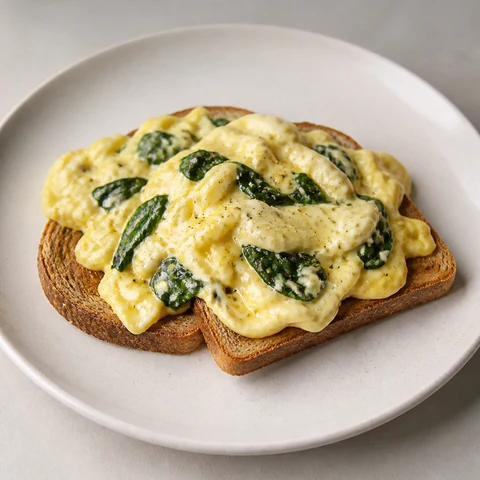
Scrambled Eggs with Spinach on Toast
Serves 2 · Prep 5 min · Cook 8 min
Soft scrambled eggs with spinach wilted through them, on wholegrain toast. Cooked in butter rather than swimming in it.
Ingredients
4 eggs (204 g)
100 g baby spinach
4 slices wholegrain bread (160 g)
15 g unsalted butter
30 ml reduced-fat milk (31 g)
0.5 g iodised table salt
Ground black pepper, to taste
Approximate per serving
1630 kJ / 389.6 kcal · protein 23.2 g · carbohydrate 32.5 g · fibre 6.8 g · fat 17 g · sodium 632.1 mg
Method
Wilt the spinach in a dry pan over medium heat for 2 minutes, then tip it into a sieve and press the water out. Wet spinach makes watery eggs.
Toast the bread.
Beat the eggs with the milk and salt. Melt the butter in a non-stick pan over low heat and pour them in.
Stir slowly, pulling the set edges into the middle, for 2-3 minutes. Fold the spinach through in the last thirty seconds.
Take them off while they still look glossy and slightly underdone; they carry on cooking in the pan. Serve on the toast with pepper.
Tomorrow
The eggs will be firmer and the toast soft. Keep the eggs and spinach, and toast fresh bread rather than reheating the slice.
Safety and storage
Keeps
3 days refrigerated below 5°C
Reheat to
steaming hot, at least 60°C
Cool and cover within two hours of cooking; split large amounts into shallow containers so they chill quickly. Reheat until steaming hot, at least 60°C.
Everyday cooking that takes reflux seriously: your own triggers rather than a blanket banned list, and evenings that sit lighter before bed, which is what current guidance supports. It works alongside your treatment, and some symptoms need a doctor rather than a different dinner.